RPM vs. CCM: Which Program Does Your Practice Need?

For some practices, RPM provides a practical starting point. For others, CCM addresses more immediate gaps in medication management, care planning, and communication between providers. Patients who qualify for both may receive both services when the applicable requirements are satisfied.
What Is the Difference Between RPM and CCM?
RPM focuses on monitoring physiologic information outside the clinic. Patients use connected devices, such as blood pressure monitors or weight scales, to transmit readings that support clinical management.
CCM focuses on coordinating care for patients with multiple chronic conditions. Services can include maintaining a comprehensive care plan, coordinating with other providers, reviewing medications, and providing ongoing patient support.
The distinction is important because collecting readings and coordinating care are separate activities.
A patient may need frequent blood pressure monitoring without requiring a comprehensive chronic care management program. Another patient may need substantial coordination across specialists and medications without needing a connected monitoring device.
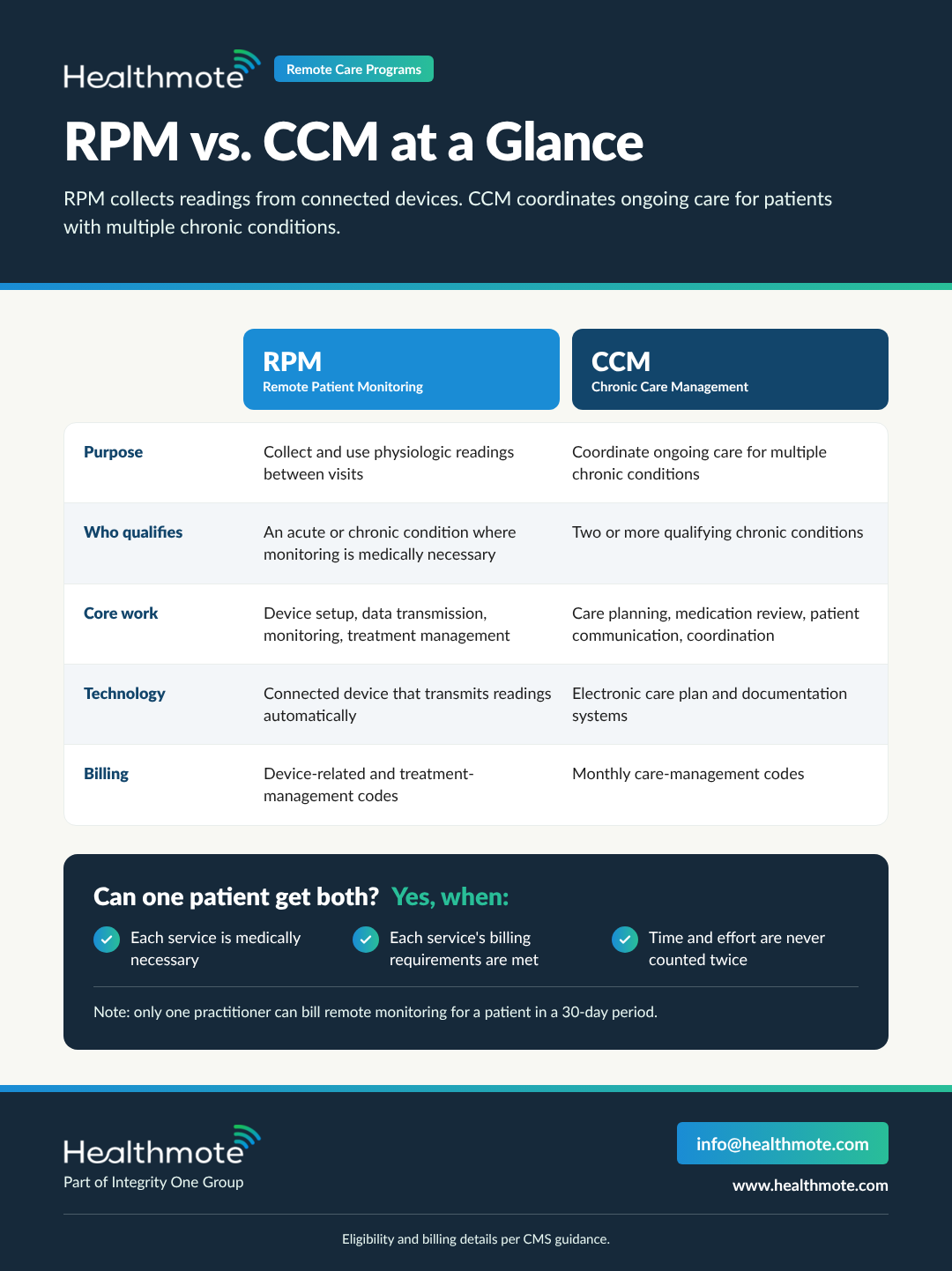
RPM vs. CCM: A Side-by-Side Comparison
The programs can complement one another, but neither automatically replaces the other.
Which Patients Are Eligible for RPM?
CMS permits Medicare RPM for acute or chronic conditions when the monitoring is medically reasonable and necessary.
The patient must use a qualifying medical device that electronically collects physiologic information and automatically transmits it to a secure location for review.
RPM also requires patient consent and an established patient relationship under Medicare's general requirements.
Examples of situations in which a practitioner might consider RPM include patients who need ongoing blood pressure, weight, or other physiologic monitoring to inform treatment decisions.
The practitioner must determine whether monitoring is appropriate for the individual patient. A diagnosis alone does not establish that every patient needs RPM.
Medicare's 2026 RPM framework also distinguishes device-supply codes based on 2–15 days or 16–30 days of transmitted data within a 30-day period. Treatment-management codes have separate requirements. (CMS)
Practices should verify the requirements for each billed code rather than applying one transmission threshold across the entire RPM program.
Which Patients Are Eligible for CCM?
Medicare CCM generally applies to patients with two or more chronic conditions expected to last at least 12 months or until death, when those conditions place the patient at significant risk of death, acute exacerbation or decompensation, or functional decline.
CCM also involves a comprehensive electronic care plan, patient consent, and access to ongoing care management services.
Depending on the applicable code, billing may require documented clinical staff time or practitioner time, along with other service-specific requirements.
CMS describes CCM as care management for patients whose chronic conditions require coordination and continued support beyond routine office visits. (CMS)
A practice should assess the patient's overall care coordination needs, not simply count diagnoses in the medical record.
When Should a Practice Choose RPM Instead of CCM?
RPM may be more appropriate when the immediate clinical need involves obtaining physiologic information between visits.
For example, a practitioner may need regular transmitted readings to assess how a patient's condition is responding to an existing treatment plan.
In this situation, the practice needs reliable device setup, patient education, transmission monitoring, and a process for reviewing readings and communicating clinically significant information.
The operational questions include:
- Can patients use the required devices correctly?
- Who monitors incoming readings?
- How are missing transmissions addressed?
- Who reviews alerts and makes clinical decisions?
- How are monitoring activities documented?
RPM should be selected because the data supports patient management, not simply because the practice has access to monitoring technology.
When Is CCM the Better Fit?
CCM may be more appropriate when a patient needs ongoing coordination across several aspects of care.
That can include communication between providers, medication-related coordination, management of a comprehensive care plan, and support addressing barriers to following the established treatment plan.
For a practice, CCM requires dependable care management workflows, consistent patient communication, and documentation of qualifying services.
A patient may have several chronic conditions but little need for connected-device monitoring. CCM may address the coordination needs more directly.
The question is whether the practice needs additional physiologic information, more structured care coordination, or both.
Can RPM and CCM Be Provided to the Same Patient?
Yes. Medicare permits RPM and CCM to be furnished concurrently when each service is medically necessary, its billing requirements are met, and time and effort are not counted twice. (CMS)
This distinction matters for practices operating integrated remote care programs.
A patient receiving RPM may have transmitted readings reviewed as part of monitoring services while also receiving separate CCM activities, such as care plan coordination or communication with other providers.
However, the same staff activity cannot be counted toward both services simply because it relates to the same patient.
Practices need clear documentation showing what was performed, why it qualified, who performed it, and which service received the associated time.
CMS also states that only one practitioner can bill remote monitoring for a patient during a 30-day period. (CMS)
That restriction makes coordination particularly important when patients receive care from multiple practitioners.
How Do Staffing and Workflows Differ Between RPM and CCM?
RPM and CCM place different demands on practice operations.
RPM requires device logistics, connectivity support, transmission tracking, monitoring workflows, and clinical escalation.
CCM requires sustained patient communication, care plan management, coordination with other providers, and accurate documentation of care management activities.
A practice offering both services should define separate workflows while allowing appropriate communication between the teams.
This helps reduce duplicated effort and makes it easier to establish which activities support each billed service.
How Should Practices Decide Which Program to Launch First?
The decision should begin with patient needs and operational readiness.
Start with a patient population review. Identify patients who may benefit from physiologic monitoring, structured chronic care coordination, or both. Confirm eligibility and clinical appropriateness before enrollment.
Assess existing staffing capacity. Determine whether the practice can support device setup, patient outreach, monitoring, care planning, and documentation without creating unresolved work.
Review technology requirements. RPM requires qualifying connected devices and dependable transmission workflows. CCM requires accessible care plans, communication processes, and reliable service documentation.
Define clinical accountability. Establish who makes treatment decisions, who coordinates care, and how concerns are escalated.
Evaluate program performance. Track meaningful operational measures rather than enrollment totals alone.
The appropriate program is the one the practice can deliver consistently for patients who need it.
How Can Healthmote Support RPM and CCM Programs?
Healthmote's remote care services include both Remote Patient Monitoring and Chronic Care Management.
For RPM, Healthmote describes device provisioning, shipping, setup, monitoring, patient outreach, clinical escalation support, and EHR-ready documentation.
For CCM, its service model includes personalized care plans, ongoing patient check-ins, medication adherence support, care coordination, and structured documentation.
As part of Integrity One Group, Healthmote contributes remote care capabilities to a broader healthcare operations and revenue cycle support ecosystem.
For practices evaluating RPM, CCM, or an integrated program, the important considerations remain patient eligibility, clinical oversight, staffing responsibilities, documentation, and applicable reimbursement requirements.
RPM provides information that supports monitoring decisions. CCM provides coordination that supports ongoing chronic care. A practice may need one, the other, or both, depending on its patients and its ability to deliver the required services.
Frequently Asked Questions
Is RPM the same as CCM?
No. RPM uses connected medical devices to collect physiologic readings for patient management. CCM provides ongoing care coordination for patients with multiple qualifying chronic conditions.
Can a patient receive RPM and CCM at the same time?
Yes. Medicare permits concurrent RPM and CCM when the services are medically necessary, all applicable requirements are met, and time and effort are not counted twice. (CMS)
Does CCM require a monitoring device?
No. CCM focuses on care planning, patient communication, and coordination of chronic conditions. Connected physiologic monitoring devices are not a general CCM requirement.
Does RPM require a patient to have two chronic conditions?
No. Medicare RPM can support monitoring of an acute or chronic condition when the service is medically reasonable and necessary. CCM has separate chronic-condition eligibility requirements.
Which program is better for a primary care practice?
Neither is universally better. RPM may address a need for ongoing physiologic data, while CCM may address complex care coordination needs. The appropriate choice depends on the patient population, clinical judgment, and operational capacity.