How to Scale RPM Across Multiple Practice Locations

Expanding an RPM program successfully means making it repeatable. A workflow that functions well at one office may become difficult to manage when several locations use different enrollment procedures, documentation methods, and escalation rules.
For multi-location practices, the goal is to create one coordinated program that can support patients across sites without losing visibility into individual locations.
Why Does Scaling RPM Across Multiple Locations Become Difficult?
A single-location RPM program may rely on familiar staff, established routines, and informal communication. As more locations participate, those arrangements become harder to maintain.
One office may enroll patients immediately after a visit, while another waits for an administrative callback. Device distribution may be coordinated centrally at one site but handled by individual staff members elsewhere.
These differences create gaps in enrollment, patient support, monitoring, and documentation.
The challenge is especially significant when practices expand RPM faster than their operational infrastructure.
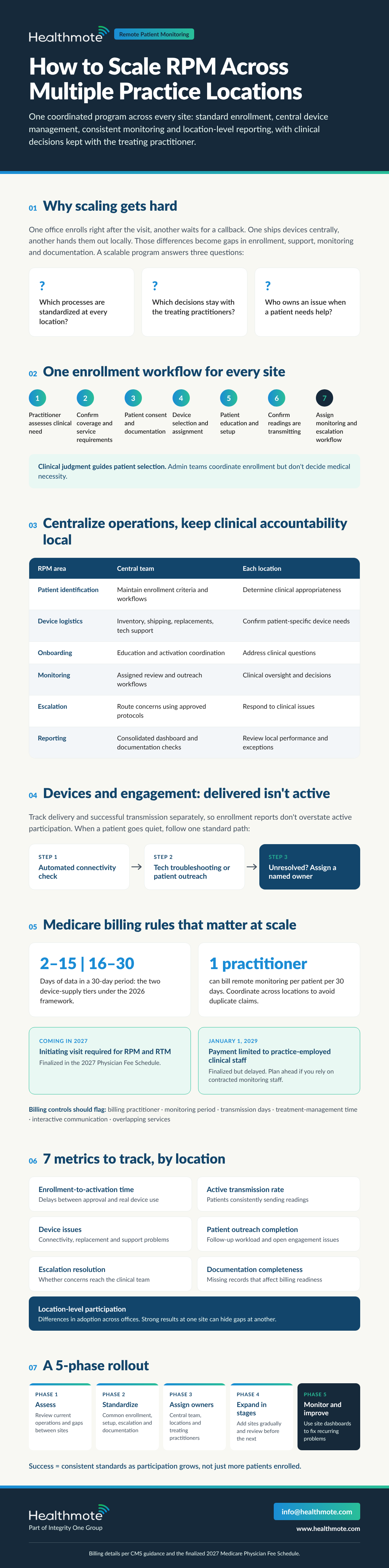
A scalable program needs clear answers to three questions:
- Which processes should be standardized across every location?
- Which decisions must remain with the treating practitioners?
- Who is responsible when a patient needs assistance or an issue remains unresolved?
How Should Practices Standardize RPM Patient Enrollment?
Enrollment should follow a consistent process, regardless of which location refers the patient.
CMS explains that Medicare RPM may be used for acute or chronic conditions when monitoring is medically reasonable and necessary. The device must meet the applicable medical-device requirements and automatically transmit physiologic data. (CMS)
Practices should establish a shared enrollment workflow that includes:
- Practitioner assessment of the clinical need for monitoring.
- Confirmation of applicable coverage and service requirements.
- Patient consent and documentation.
- Device selection and assignment.
- Patient education and setup.
- Confirmation that readings are transmitting successfully.
- Assignment to the appropriate monitoring and escalation workflow.
Clinical judgment should guide patient selection. Administrative teams can coordinate enrollment, but they should not independently determine whether monitoring is medically necessary.
A standardized process also makes it easier to identify where patients are dropping out before monitoring begins.
Should RPM Monitoring Be Centralized Across Locations?
Centralization can simplify device support, patient outreach, documentation, and operational reporting.
Instead of asking every office to manage its own monitoring infrastructure, a multi-location organization can establish shared workflows supported by a central team.
However, centralized operations should not obscure clinical accountability.
The treating practice needs to know who reviews incoming readings, which personnel handle patient communication, and how clinically significant information reaches the responsible practitioner.
This model provides operational consistency without treating every patient or location as interchangeable.
How Can Practices Manage RPM Devices Across Multiple Sites?
Device management becomes more complicated as enrollment increases.
A practice needs to know which devices are available, which patients have received them, whether they are transmitting, and which devices require replacement or retrieval.
A centralized inventory process should track device assignment, shipping status, activation, connectivity problems, and returns.
The onboarding process should also confirm that patients can use their devices correctly.
CMS identifies patient education and setup, device supply, and treatment management as core components of RPM services. (CMS)
A device delivered to a patient is not necessarily an activated device.
Track device delivery and successful transmission separately so enrollment reports do not overstate active participation.
How Do You Keep Patients Engaged as an RPM Program Grows?
Patient engagement requires consistent follow-up after initial setup.
Patients may stop transmitting readings because of connectivity issues, difficulty using the device, changes in routine, or uncertainty about the monitoring process.
A scalable program should establish a standard response to inactivity.
For example, the workflow might begin with an automated connectivity check, followed by technical troubleshooting or direct patient outreach. Unresolved issues should be assigned to a named team member.
Each location should use consistent procedures for documenting contact attempts and identifying patients who need additional assistance.
The objective is to distinguish technical problems from patient engagement concerns and ensure neither remains unresolved.
What Medicare Billing Requirements Matter When Scaling RPM?
As organizations expand, documentation consistency becomes increasingly important.
Under the 2026 Medicare framework, remote physiologic monitoring device-supply codes distinguish between 2–15 days and 16–30 days of data collection in a 30-day period. Treatment-management services have separate time and interactive-communication requirements. (CMS)
CMS also states that only one practitioner can bill remote monitoring for a patient during a 30-day period. This makes coordination especially important when patients receive care from multiple practitioners or locations. (CMS)
For multi-location practices, billing controls should identify:
- The practitioner responsible for billing.
- The patient's monitoring period.
- Device transmission activity.
- Documented treatment-management time.
- Required interactive communication.
- Potentially overlapping services or duplicate billing.
An important upcoming change: The finalized 2027 Medicare Physician Fee Schedule establishes an initiating-visit requirement for RPM and RTM beginning in 2027. CMS also finalized a requirement limiting payment to services performed by practice-employed clinical staff, but delayed that restriction until January 1, 2029. Organizations relying on contracted monitoring personnel should account for this future policy when developing expansion plans. (CMS)
The 2029 restriction is finalized policy with a future effective date, not a requirement currently in effect.
Which RPM Metrics Should Multi-Location Practices Track?
A consolidated dashboard should provide both organization-wide visibility and individual location performance.
Without location-level reporting, strong results at one office can conceal onboarding delays or documentation gaps elsewhere.
Review trends regularly and investigate the underlying causes of performance differences.
A location with low activation may need better onboarding support. Another with frequent unresolved alerts may need clearer escalation ownership.
What Is a Practical Framework for Expanding RPM?
A phased rollout allows practices to test processes before expanding them across the organization.
Phase 1: Assess existing operations. Review current enrollment, device management, staffing, monitoring, and reporting. Identify inconsistencies between locations.
Phase 2: Standardize workflows. Establish common procedures for enrollment, consent, setup, monitoring, escalation, and documentation.
Phase 3: Define responsibilities. Assign ownership to central teams, individual locations, and treating practitioners.
Phase 4: Expand in stages. Add locations gradually and review activation, engagement, documentation, and unresolved issues before proceeding.
Phase 5: Monitor and improve. Use location-level dashboards to identify recurring problems and adjust workflows.
The rollout should be considered successful when the organization can maintain consistent operational standards as participation grows, not simply when more patients have been enrolled.
How Can Healthmote Support Multi-Location RPM Programs?
Healthmote's remote patient monitoring services are designed to support practices with device provisioning, shipping, setup, monitoring, patient outreach, clinical escalation support, and EHR-ready documentation.
As part of Integrity One Group, Healthmote contributes remote care capabilities to a broader healthcare operations and revenue cycle support ecosystem.
For organizations operating across multiple locations, a coordinated service model can help standardize administrative workflows and reduce the need for every office to build separate RPM support processes.
Practices should evaluate the specific staffing, clinical oversight, integration, reporting, and compliance responsibilities included in any service arrangement, particularly in light of the finalized Medicare requirements scheduled for 2027 and 2029.
Scaling RPM is ultimately an operational decision. Practices need consistent processes, accountable teams, and reliable visibility into what happens after patients enroll.
Frequently Asked Questions
Can one RPM program support multiple practice locations?
Yes. A multi-location organization can use shared administrative workflows and monitoring infrastructure, provided clinical responsibilities, patient records, supervision, and billing requirements are appropriately managed.
Should each location manage its own RPM devices?
Not necessarily. Centralized device inventory, shipping, and technical support can provide consistency, while individual locations retain responsibility for patient-specific clinical decisions.
How can practices improve RPM enrollment across locations?
Use standardized enrollment criteria, consistent patient education, documented consent, device activation checks, and regular reporting on patients who have not completed onboarding.
Can multiple locations bill RPM for the same patient?
CMS generally permits only one practitioner to bill remote monitoring for a patient in a 30-day period. Practices should coordinate billing responsibilities to prevent overlapping claims. (CMS)
What is the biggest challenge when scaling RPM?
Maintaining consistent workflows and clear accountability across locations. Enrollment, monitoring, escalation, and documentation must remain coordinated as the program expands.